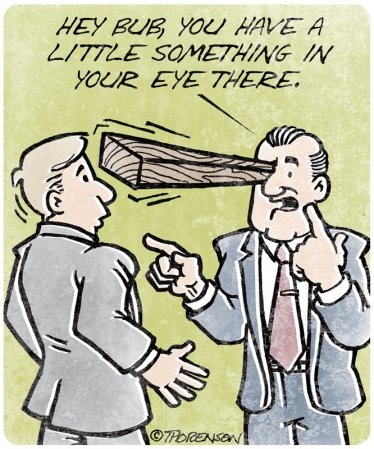
Sadly, Christians are often known for being hypocritical (saying one thing and doing another). Unfortunately, because we are all human, that reputation tends to be accurate more than we would like. It is so easy to tell someone the right thing to do, even if we aren’t doing it ourselves. Everyone has an opinion it seems, even if we aren’t applying those truths in our own lives. The Bible addresses this very issue in Matthew 7:3 (ESV), “Why do you see the speck that is in your brother’s eye, but do not notice the log that is in your own eye?” It is always easier to look at what someone else is doing wrong than admit our own faults. Just like it would be impossible to help someone get a speck out of their eye while we walked around with a log in our own, it is impossible for us to truly be effective with helping other people while we refuse to deal with our own issues.
Growing up, I was probably one of the most judgemental people you would meet. I hate that about myself. I had an opinion about everyone and everything. Sadly, most of those opinions were based on limited information and even more limited life experiences. I had not learned the value of putting myself in someone else’s’ shoes. Thankfully, although I still struggle with this from time to time, I have learned a lot about pausing before formulating an opinion in the past several years. Teaching has been incredibly valuable in this learning process. As a teacher I deal with a lot of variables on a daily basis. The biggest being the kids I teach. They come from vastly different home lives, some great, some devastatingly sad. This has taught me such a lesson about judging before you know the backstory. Another thing that has taught me this is being married to a school administrator. When you are not the person ultimately making decisions and having to follow rules, laws, and procedures, it is easy to complain and have an opinion about how things should be done. However, when those things fall on you, the simple fix is often not plausible. Often, as is true in most of life, everything isn’t always black and white. Those simple fixes that we can easily come up with without all the information, are often unreasonable in the real world.
So, what should we do? I don’t believe that we should stop trying to help simply because we are imperfect and have our own set of issues. However, I do think that it is vital to do a whole lot more listening to others than telling them what to do. Over the last several years this has been something that I have really felt like God has been teaching me. It’s been amazing to me how being aware of this tendency of mine has actually caused me to have more compassion when dealing with a difficult situation or person. I have even found myself praying more for those difficult people because I have realized that there is a backstory to why they are causing me frustration or pain. The Bible speaks loudly on this subject of forgiving others and being compassionate in regards to the faults of others:
“Make allowance for each other’s faults, and forgive anyone who offends you. Remember, the Lord forgave you, so you must forgive others. Above all, clothe yourselves with love, which binds us all together in perfect harmony. And let the peace that comes from Christ rule in your hearts. For as members of one body you are called to live in peace. And always be thankful. Let the message about Christ, in all its richness, fill your lives. Teach and counsel each other with all the wisdom he gives. Sing psalms and hymns and spiritual songs to God with thankful hearts. And whatever you do or say, do it as a representative of the Lord Jesus, giving thanks through him to God the Father.” Colossians 3:13-17 (NLT)
My pray is that we would all take this advice and strive to be a better representative of Jesus every single day!
 Becki Koepke